
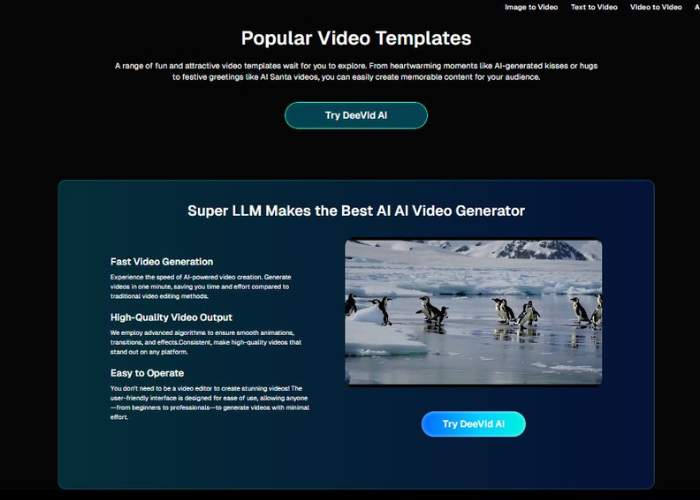
Deevid Ai comes in confidence. Without a mysterious menu, without overloading jargon – it's just “video text”, “image to video”, “effect video” and all the like, all carefully set in the queue. This simplicity was a relief – just as they kept the map clearly, so I could focus on creating movies, not looking for buttons.
There is a promise of a film style – in a few minutes write your text, images or clips in a smooth, elegant video content. This is a great conversation, so I had to see it for myself.
CO deevid.Ai brings to the table (according to the site)
From their official list of functions:
- Text-to-video: You write, and watches – boom, video.
- Image-video: Avatar scenes, product photos or random selfies revived with camera movements.
- Video / style video transfer: Replacement styles – retro, anime, vibes ghibli – you call it.
- Templates and effects: AI “Hugs”, “Kisses”, even Ghibli -style filters.
- Fast rendering: He says one minute per clip.
- Privacy control points: Data encryption, no sharing, safe content generation.

Placing it – three real experiments
- Text-to-video
I entered: “An interesting fox moves through the moonlight, leaves Rzeleszko under the foot, the camera circles strongly on a watchful creation.” I got a short clip – about 5 seconds – active movement, mood lighting, forest blur. A bit unclear but atmospheric.
The generation was indeed less than a minute, and the export remained smooth. - Image-to-Video (fuel consumption)
I used a static photo of the product – a cozy cup on the desk – and asked for a zoo and a film pan. Ai added movement and slow cinema sweeping. Solid work for promotional use. - Changing the video style to the video
I took a shot of the drone during the day and switched to the “vintage” style. The result was consistent-as the film's supplies at the beginning of 2000-but some frames seemed to be chopp. Despite this, the speed of changing the slider helped, and the performance remained of high quality.
Pros and “Can-Be-Betters” in the form of a table
| Function | Where it shines | Quirks you should know about |
| Speed and ease | One -minute render, a nice interface based on a browser | Limited control over the nuance of the movement |
| Visual quality | Cinema character, smooth export 1080p | Some models show colorful bands or blur of artifacts |
| Style filters and templates | Funny, ready effects, such as “Ghibli AI” | Depending on preliminary settings – customary control is limited |
| Input variety | Supported text, image or clip input | Limited output length; tight lengths of clips |
| Privacy / data security | Encrypted messages; The rules are clear | Red flags were found |

Real conversation – how was it to use deevid.ai
I presented my honest participation in awkward AI video editors. Deevid hit differently because he let me play-no permanent error, no tool hunting. I felt invited to push the hints, browsing it and adapt a mini social clip.
Sure, the synchronization of the lips and movement still bends a bit synthetically. The cinema gloss is not Polish at the Pixar level-but the flow of work in the turnover means that it does not have to be. For marketers, teachers or solo creators who only want a quick visual blow, it is child's play.
Last word – is deevid.Ai is worth it?
If you are looking for fast, creative, and filmos without struggling any editing software, Deevid is convincing. It brings style, speed and ease – with small limits that can be creatively tilted.
General grades:
- Ease of use: 9/10
- Visual output: 8/10
- Play factor: 8.5/10
- Value: 8/10
Lower line: It is not ideal for the length or hyperreal function, but on fast, stylish clips. Do you need a comparison with Pollo AI, Vidnoz or alternatives? I can do it – just say the word.