

While the headlines surrounding the ongoing AI revolution are often dominated by large language models and generative software, a silent war is taking place in the data center. The hardware necessary to power, train, and infer these models is undergoing a radical transformation. It is in this context Lenovo announcement dated December 10, 2025, please review the new ThinkSystem and ThinkAgile wallets.
Lenovo presented a wide range of solutions for data storage, virtualization and management services. On the surface, this is a product refresh. But viewed through the lens of Lenovo's historical trajectory and current market position, this represents a calculated attack on the “technical debt” that is crippling many enterprises trying to transition to AI.
The Big Blue legacy: the foundation of enterprise trust
To understand why Lenovo is arguably the dark horse of the enterprise data center, you have to go back to 2014, when Lenovo acquired IBM's x86 server division. Industry reaction was mixed. Critics noted that the PC maker exceeded expectations; visionaries saw a massive transfer of intellectual property and corporate DNA.
This acquisition not only expanded the product line; it immediately gave Lenovo a seat at the Fortune 500 table. By inheriting the System x line, Lenovo wasn't just buying servers; bought from IBM decades of engineering experience, deep-rooted channel relationships, and a reputation for reliability that a consumer brand couldn't build organically in a decade. This early positioning allowed Lenovo to bypass the “new entrant” stigma. We didn't start from scratch – it was a continuation of a legacy. This credibility is the foundation on which today's announcement is based. When Lenovo brings ThinkSystem DS storage arrays to market today, it does so with the engineering expertise that enterprise CIOs have trusted for three decades.
Global scale, local scope: multinational advantage
In an era of geopolitical fragmentation and supply chain instability, Lenovo's unique dual-site structure (Beijing and Morrisville, North Carolina) and manufacturing footprint provide a distinct advantage over competitors such as Dell and HPE.
Lenovo describes its strategy as “global-local.” Maintaining production plants in HungaryMexico, India, China and the United States, can provide a level of supply chain resilience that is difficult to replicate. For an international enterprise customer, this means Lenovo can navigate tariffs, shipping logistics and regional compliance standards with greater flexibility than a competitor that relies on a centralized manufacturing hub. The new ThinkAgile FX and MX series announced today go beyond just hardware specifications; are supply chain products designed to survive disruption, ensuring that when an enterprise decides to modernize its infrastructure for AI, the equipment actually arrives.
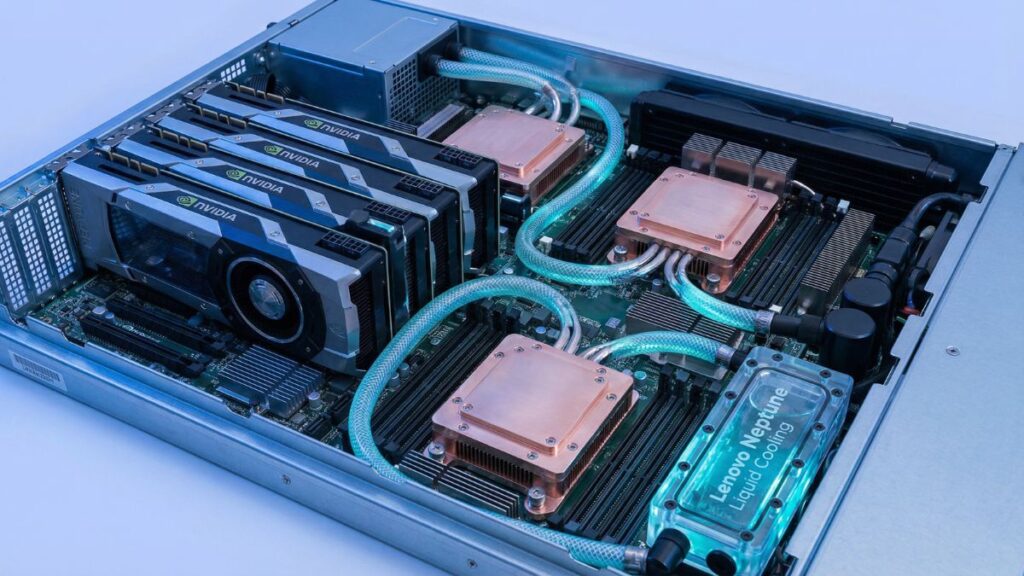
Neptune™: cool factor in a hot market
Perhaps the strongest differentiator in Lenovo's arsenal—and one that makes this announcement's focus on high-performance computing (HPC) feasible—is Neptune™ liquid cooling technology.
As AI workloads require denser GPU configurations (such as the ThinkAgile MX series with NVIDIA RTX Pro 6000 mentioned in the announcement), heat dissipation becomes a limiting factor. Traditional air cooling is reaching its physical limits. Lenovo has been working on liquid cooling for over a decade, long before the current AI boom made it a necessity.
While competitors attempt to modernize liquid cooling solutions or partner with niche vendors, Lenovo has been integrating direct-to-node warm water cooling into its architecture for years. This significantly reduces data center operating costs, which is a critical selling point for CFOs who are signing off on these massive AI infrastructure upgrades.
Announcement Analysis: Storage as an AI Bottleneck
The press release highlighted a shocking statistic from IDC: “80% of storage deployed over the last 5 years is based on slower hard drives.” It is the “hidden killer” of AI projects. You can have the fastest GPUs in the world, but if the data pipeline becomes clogged with spinning rust (hard drives), model training will stop.
New Lenovo ThinkSystem DS storage arrays they are a direct response to this. By delivering an all-flash solution that is simple to deploy, Lenovo is democratizing the speed required for artificial intelligence. He effectively tells his customers, “Stop trying to start Ferrari engines on dirt roads.”
In addition, ThinkAgile HX Series for Artificial Intelligenceequipped with Nutanix Enterprise AI software stack, takes into account the complexity of implementation. Virtualization strategies are currently in constant flux (primarily due to market changes in the hypervisor space), and enterprises are desperately looking for open, flexible alternatives. By leveraging HCI (hyperconverged infrastructure) for seamless solution conversion, Lenovo offers an “insurance policy” against vendor lock-in, which is very attractive to cautious CIOs.
Competitive positioning and market reception
This announcement positions Lenovo not only as a hardware supplier, but also as a holistic infrastructure partner. By combining hardware with hybrid cloud consulting and implementation services, Lenovo realizes that the barrier to implementing artificial intelligence is not only technology, but also skills.
The ThinkAgile MX Series for your on-premises Microsoft Azure environment is particularly strategic in nature. It acknowledges a hybrid reality: data gravity is real. Companies cannot cheaply and legally move petabytes of sensitive data to the public cloud. By enabling Azure capabilities on-premises through optimized hardware, Lenovo secures its place in the hybrid cloud ecosystem by serving as a bridge between the data center and hyperscalers.
Summary
Lenovo's December 10 announcement is a masterclass in room reading. The critical pain points of the modern enterprise – slow data storage, cooling inefficiencies and virtualization uncertainties – were identified and addressed with a mature, high-performance portfolio. Leveraging the engineering legacy of Lenovo's acquisition of IBM, the resiliency of a truly global supply chain, and Neptune's thermal innovations, Lenovo has positioned itself as a pragmatic partner in the age of artificial intelligence. For enterprises drowning in data but hungry for knowledge, new ThinkSystem and ThinkAgile solutions are a lifesaver.

As President and Chief Analyst of the Enderle Group, Rob provides regional and global companies with guidance on creating a credible dialogue with the market, reaching customer needs, creating new business opportunities, anticipating technological changes, selecting suppliers and products, and practicing zero-dollar marketing. For over 20 years, Rob has worked for and with companies including Microsoft, HP, IBM, Dell, Toshiba, Gateway, Sony, USAA, Texas Instruments, AMD, Intel, Credit Suisse First Boston, ROLM and Siemens.


